Saturday, December 14, 2013

About 2 percent of Iranian population suffers from Hepatitis B


Photo: About 2 percent of Iranian population suffers from Hepatitis B / Society
Baku, Azerbaijan, Dec. 14
By Umid Niayesh- Trend:
About 1.4 million Iranians suffer from Hepatitis B, which indicates that average prevalence of the disease is about 2 percent, head of the Iran Hepatitis Network, Seyed Moayed Alavian said, Fars news agency reported on Dec. 14.
The world countries are divided in three groups of low, medium and high in terms of hepatitis infection prevalence, Alavian said, adding that Iran ranks medium in terms of the infection prevalence.
He also estimated that about 200,000 Iranians have Hepatitis C. The Hepatitis C prevalence is about 0.5 percent, Alavian added.
On July 29, ISNA quoted faculty member of Tehran University of Medical Sciences, Nasser Ebrahim Daryani as saying the number of people infected with Hepatitis C has increased in Iran.
He also noted that "at the same time the amount of people infected with Hepatitis B has also decreased."
"Of all drug addicts, about 40 percent have Hepatitis C," Daryani said, adding that the number of injecting drug users in the country has grown as well.
He noted that most of the time both Hepatitis B and C develop with single men, and those who serve sentences in prisons.
In October 2012, Deputy Head of Iran's Drug Control Headquarters Taha Taheri said there are more than 100,000 prisoners in Iran, serving sentences for drug-related crimes.
According to official statistics, there are about 2 million drug addicts living in Iran.
Follow us on Twitter @TRENDNewsAgency

Studies: Current hepatitis C treatments can’t be used by more than half of patients; others lose opportunity for treatment

Studies: Current hepatitis C treatments can’t be used by more than half of patients; others lose opportunity for treatment

By , | Health | 0 Comments

DETROIT – More than half of chronic hepatitis C patients studied in a new research project led by Henry Ford Hospital were not treated for the potentially fatal disease, either because they couldn’t withstand current therapies or because they, or their doctors, were waiting for new treatments.
In a second, related study, Henry Ford researchers found that while the disease is not yet curable, there is a significant “lost opportunity” for hepatitis C patients to achieve the current best result of treatment.
Both studies were presented at the annual meeting of the American Association for the Study of Liver Diseases being held in Washington, DC.
Stuart C. Gordon, M.D., director of the Hepatology section at Henry Ford, and lead author of the first study, said it was launched because of a lack of information about the subject.
“Limited data exist concerning the clinical disposition of U.S. patients with chronic hepatitis C infection, including the reasons for lack of antiviral treatment,” Dr. Gordon says. “Our goal was to add to that data.”
The team collected electronic health records from four large American health systems of patients with confirmed chronic hepatitis C, a viral infection that progressively scars the liver and eventually destroys the organ and its vital functions.
Of these 4,271 patients diagnosed with the infection and still alive through the end of 2011, the median age was 57; 57 percent were male; 29 percent were black and 97 percent were insured.

  • 543, or 12.7 percent, had previously achieved a sustained virologic response (SVR), meaning the hepatitis C virus was suppressed to the point that it could no longer be detected in their blood for six months after anti-viral treatment.
  • 110, or 2.6 percent, were currently on anti-viral therapy.
  • Of the remaining 3,618 patients, 12 percent had never been followed up within the health care system, despite clinical confirmation that they had chronic hepatitis C.
  • The majority, 55 percent, were not being treated, either because of “absolute contraindications” to current therapy – meaning the risk of available treatment is too high – or because either the patient or physician were waiting for newer therapies.
  • Another 12 percent of patients had chosen not to start treatment, despite a doctor’s recommendation to do so.
“These results confirm that only a small proportion of chronic hepatitis C patients in American health care systems who were still being followed at the end of 2011 had achieved an SVR with available antiviral regimens,” Dr. Gordon said. The second study sought to identify “lost opportunities” to treat hepatitis C patients and achieve SVR, now the closest thing to a “cure” for the disease.
“We looked at data regarding testing for chronic Hep C, patient referral, patient visits and the start of treatment,” explains Kimberly Ann Brown, M.D., division head of Gastroenterology at Henry Ford Hospital and lead author of the study’s findings.
“In addition,” Dr. Brown says, “we considered patient age, race, gender, income, marital status, psychiatric diagnoses and the number of comorbidities, or co-existing diseases.”
The findings showed that of the 458 patients identified with a positive hepatitis C antibody, only 117 received confirmatory testing, were referred to a specialist and presented to the office for a visit. Of the 117 patients who came for the specialty visit, only 21, or 17.9 percent, were felt to be appropriate treatment candidates.
“This data speaks to the significant “lost opportunity” we have, not only in identifying patients with hepatitis C in our community, but also in providing them with appropriate treatment options,” says Dr. Brown.

Gilead Sciences, Inc. (GILD)’s $1,000 Per Day Sovaldi Pills Ready to Launch

Gilead Sciences, Inc. (GILD)’s $1,000 Per Day Sovaldi Pills Ready to Launch


Last Friday, the Food and Drug Administration approved Gilead Sciences, Inc. (NASDAQ:GILD)‘s Sovaldi for the treatment of chronic hepatitis C.
Since Gilead acquired Sovaldi, together with its developer Pharmasset, for $11 billion in November 2011, now it’s the time for both Gilead and its investors to reap the reward of their investment.
Gilead Sciences, Inc. (NASDAQ:GILD)
Gilead Sciences, Inc. (NASDAQ:GILD) decided to set the wholesaler acquisition cost of Sovaldi at $28,000 for a 28-tablet bottle, or $1,000 per day. That translates to $84,000 for the 12 weeks of treatment recommended for most patients, and $168,000 for the 24 weeks needed for a hard-to-treat strain of the virus.
Since chronic hepatitis C affects an estimated 4 million people in the United States and more than 150 million worldwide, the financial reward could be enormous. Sovalid’s sales are also expected to be strong from the start because many patients, on the advice of their doctors, have been putting off starting treatment until Sovaldi became available.
Hepatitis C virusThe hepatitis C virus is an enveloped single stranded RNA virus that needs to penetrate a host cell, which is generally a hepatocyte, in order to replicate. Once it replicates, the virus slowly damages the liver, leading to cirrhosis and in some cases to liver cancer. There is no protective vaccine against hepatitis C virus, and standard treatment regimens are often ineffective or toxic to the patient.
SovaldiThe genome of the hepatitis C virus encodes three structural proteins (C, E1 and E2) and six non-structural proteins (NS2, NS3, NS4A, NS4B, NS5A, and NS5B).
Sovaldi is an oral nucleotide analog inhibitor of the hepatitis C Virus NS5B polymerase enzyme, which plays an essential role in the virus replication.
Sovaldi’s efficacy has been established in patients with hepatitis C viruses that are infected with one of four different genotypes of the virus, and the FDA granted it priority review and breakthrough therapy designation because it offers high cure rates on a shortened 12-week course of therapy for many patients.
CompetitionThe current standard of care for hepatitis C involves up to 48 weeks of therapy with a pegylated interferon and ribavirin regimen, which may not be suitable for certain types of patients. Sovaldi is the first ever oral treatment regimen for genotypes 2 or 3 and the first regimen for patients awaiting liver transplantation to prevent hepatitis C virus recurrence, so there relatively no competition in this particular space.
However, AbbVie Inc (NYSE:ABBV)Bristol-Myers Squibb Co (NYSE:BMY) and Johnson & Johnson (NYSE:JNJ) are developing similar all-oral regimens for hepatitis C that could reach the market in the next one to three years.
In September this year, the FDA approved Johnson & Johnson’s new chronic Hepatitis C drug Olysio for use in the treatment of patients suffering from genotype 1 of the disease. Genotype 1 constitutes roughly 70% of Hepatitis C cases in the U.S. and is the most common form of the disease globally. According to some estimates, the new drug could achieve sales of over $450 million by 2016.
AbbVie is developing a three drug treatment regimen of ABT-333, ABT-450 and ABT-267. AbbVie’s drug combination tested well and, according to the company, its interferon-free hepatitis C therapy showed roughly 96% of the patients who took the combination had no detectable levels of the virus after 12 weeks of therapy.
The FDA has given AbbVie Inc (NYSE:ABBV)’s hepatitis C antiviral regiment, both alone and taken in combination with ribavirin, a Breakthrough Therapy designation, which could prove a swift review and an early launch.
Bristol-Myers Squibb Co (NYSE:BMY) is developing a daclatasvir-plus-asunaprevir treatment regimen in late phase 3, and, according to the company, the therapy might receive approval in Japan soon.
Valuing Gilead
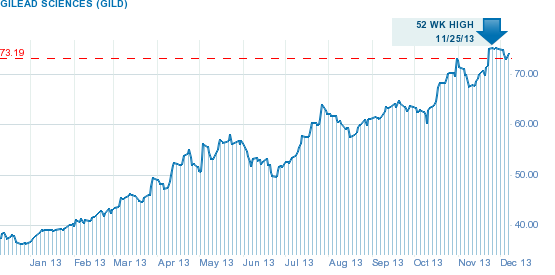
Gilead Sciences, Inc. (NASDAQ:GILD) shares, which have doubled in value since the beginning of the year, are currently trading near their all-time highs. The company, which trades at a P/E ratio of 48, has generated $8.8 billion in the first nine months of the year and is expected to close the year with $10.4 billion in revenue. Since Gilead is currently valued at $114 billion, its 2013 price-to-sales ratio can be estimated at 10.
Matthew Roden, an analyst at UBS, said in a note recently that annual sales could surpass the record of around $13 billion achieved by Pfizer Inc. (NYSE:PFE)‘s Lipitor. That is more than Gilead’s present total annual revenue levels and the comment would definity bring pure joy to many of Gilead’s long-term investors.
Foolish takeawayAlthough Sovaldi’s approval was much anticipated by the investment community and has been factored in Gilead Sciences, Inc. (NASDAQ:GILD)’s share price, the sheer magnitude of hype and publicity surrounding the launch are likely to raise volatility in the stock with an upside bias.
The article Gilead Sciences’ $1,000 Per Day Sovaldi Pills Ready to Launch originally appeared on Fool.com.
Fool contributor Jan Robison owns shares of Gilead Sciences. The Motley Fool recommends Gilead Sciences, Inc. (NASDAQ:GILD) and Johnson & Johnson. The Motley Fool owns shares of Johnson & Johnson (NYSE:JNJ).
Copyright © 1995 – 2013 The Motley Fool, LLC. All rights reserved. The Motley Fool has adisclosure policy.